


Our Edge AI Low-Light Full-Color Technology processes RAW Bayer data upstream of the ISP, using multi-frame RAW fusion and deep-learning denoising to enhance color, brightness, and fine detail in extremely low-light conditions. By keeping processing on-device, it enables vision device manufacturers to support real-time full-color video on compatible existing camera hardware while reducing reliance on premium sensors, large-aperture optics, and auxiliary lighting.
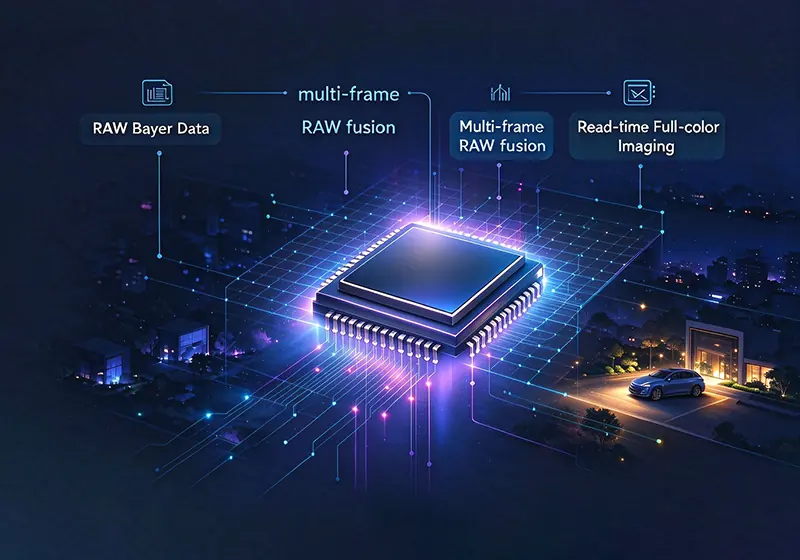
Improves color reproduction, noise control, and fine detail in near-dark conditions for clearer nighttime full-color imaging.
Designed for compatible existing camera platforms, reducing reliance on premium sensors, large-aperture optics, and auxiliary lighting.
Real-time, low-latency on-device processing that can support privacy-sensitive product designs.

A: No, not necessarily. The algorithm offers greater flexibility in sensor, lens, and illumination choices, reducing reliance on premium optics and auxiliary lighting. Final image quality still depends on the sensor, lens, exposure settings, and overall imaging pipeline.
A: No. It operates on RAW Bayer data upstream of the ISP pipeline, combining multi-frame RAW fusion with deep-learning denoising before standard ISP processing.
A: Integration may be possible if the platform provides access to RAW Bayer data and sufficient available compute resources. We assess the chipset, image sensor, target resolution, and frame rate to confirm feasibility.
A: No dedicated white-light illumination is required for the algorithm itself. It is designed for products where intrusive visible light is a concern — such as baby monitors or residential security — while supporting natural full-color nighttime imaging.
A: Conventional ISP pipelines may include spatial and temporal noise reduction, but our technology processes RAW Bayer data before standard ISP processing. It combines multi-frame RAW fusion with deep-learning denoising to improve color reproduction, brightness, noise control, and fine detail in extremely low-light conditions.
A: The technology is designed for extremely low-light imaging. Actual performance depends on the image sensor, lens aperture, exposure settings, resolution, frame rate, and overall imaging pipeline. We evaluate achievable low-light performance on a per-platform basis.
A: Potential applications include security and surveillance cameras, smart home cameras, baby monitors, intelligent transportation systems, industrial vision and inspection cameras, wildlife and trail cameras, drones and robotics, automotive vision systems, and other intelligent vision devices requiring full-color imaging in extremely low-light environments.
A: No. The algorithm itself runs entirely on-device. AI processing is performed locally, and image data does not need to be uploaded to the cloud for the algorithm to operate. Cloud connectivity is a separate system-level decision and is not required by this technology.
A: We typically require the chipset model, image sensor specifications, RAW data access method, target resolution and frame rate, available compute resources, and sample nighttime footage. An NDA can be signed before detailed hardware or platform information is shared.